CHARLIE
          I'm not sure an Error Correcting Code
          is gonna get you there --
            (off tense looks)
          -- That is what you're using, right?

                    AMITA
          ...And have been for weeks.
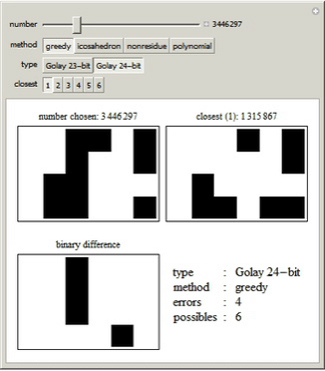
When the Voyager spacecraft took pictures of Saturn and Jupiter, they used
Golay code to encode the data for transmission. Each 24-
bit block of data could have up to three errors, and
the computers here on Earth could fix these errors. The Golay code is thus an
error-correcting code. It was
originally published in 1949 with Marcel Golay's half-page paper, "Notes on Digital Coding." Today, this
paper is considered one of the most remarkable papers ever published, with deep, deep connections to
group theory,
graph theory,
number theory,
combinatorics,
game theory, multidimensional geometry, and even
particle physics.
                    NIKKI
            (slides a statement across)
          Bank statements don't lie --

                    EMERSON
          I have 511,108 dollars and 23 cents.
          Tomorrow it'll be 511,114 dollars and
          17 cents.  Compounded daily.  At our
          preferred introductory rate.
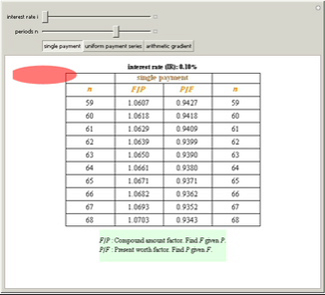
Compound interest tables are useful for
looking up interest compounded at various rates.
Charlie eyes the box: "QUANTITY: 150" In his palm are the 3
paper clips he plucked out.

                    CHARLIE
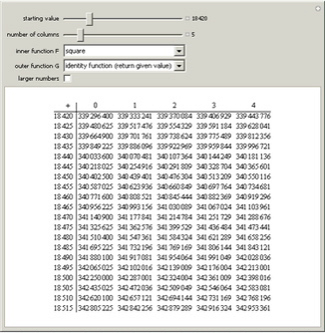
          What's 364 squared?

                    EMERSON
          132,496.

                    CHARLIE
          The square root of 7?

                    EMERSON
          2.645751311106 --
                    AMITA
          You mentioned Fractal Analysis...?

Charlie holds her look, the fence-mending begins...

                    CHARLIE
          It came to me staring at a poster of
          a drip painting on Emerson's wall...
          how he sees the world -- whether in
          an abstract painting, or a barcode,
          or in the way he arranges seemingly
          random clutter in his apartment --

                    LARRY
          -- it's all part of a larger design,
          a fractal pattern...

                    AMITA
          ...shapes repeating within the same
          object -- like a snowflake.
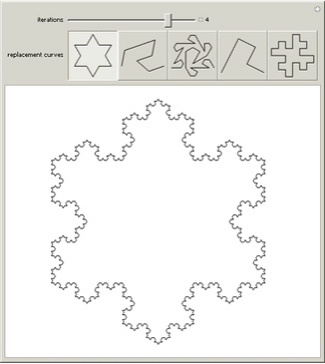
Fractal curves can be generated from an initial
curve (often a regular polygon) and one or more replacement curves. Repeatedly, each line is replaced by a properly
scaled copy of one of the replacement curves. The buttons show the first iteration of the replacement curve used. The
fractal illustrated above is known as the
Koch
snowflake.